
Adaptive Modeling Language(AML) is an object-oriented, knowledge-based engineering modeling framework. AML enables multidisciplinary modeling and integration of the entire product and process development cycle. No other commercial framework or development environment provides the full range of capabilities that AML includes out of the box.
In the design and analysis phases, geometry is often the center of a product’s definition. AML provides a geometry-centric environment with support for both manifold and non-manifold solid, surface, and wireframe modeling capabilities.


Computation in AML is innately demand-driven, utilizing automatic dependency tracking between objects and properties to compute only that which is required. As a result, AML makes the most of the computing resources that are available.
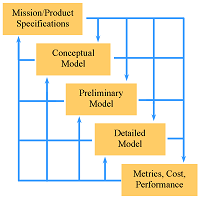
AML enables generative modeling, which leaps beyond the present CAD/CAM/CAE approach to integrated design and analysis processes. In a generative modeling environment, knowledge of the engineer’s tools and the intricacies associated with executing them is captured within a modeling language. This empowers the engineer to search a broader set of product design configurations, rather than being limited to simple parameter changes.
AML provides methods for automating finite element modeling and mesh generation based on either native or imported geometry, including both structured and unstructured approaches. Interfaces to pre- and post-processors and solvers including MSC Patran©, Nastran, ANSYS©, LS-DYNA©, MARC©, STAAD©, and ROBOT© are available.

A complete mathematical modeler is built into AML, providing access to logical operators, mathematical functions, matrix manipulation, and looping constructs.
Pre-defined classes are provided to quickly create custom interfaces to ODBC-compliant databases utilizing SQL.
Integration to third-party applications is accommodated through a number of standard methodologies, including shared memory, pipes, TCP/IP sockets, file transfer, and foreign functions (C and Fortran).
Options are available within AML for import and export to industry-standard file formats, including IGES, STEP, STL, and DXF.
Built-in XML export capability enables a state model of the AML object hierarchy and geometry to be automatically exported to an XML file, which is viewable using TechnoSoft’s AML Viewer. The available “Net Conference” mode enables real-time collaboration among team members across local and global computer networks.
A suite of graphical user interface (GUI) classes is provided to allow developers to create customized front-ends to their AML applications. In addition, a visual GUI-builder can be used, making it easier to layout forms and controls, and assign their associated methods and properties.
AML provides native support for multiple operating systems (including Microsoft Windows, SGI, HP, IBM, and Sun), parallel processing, and cross-platform distributed computation.